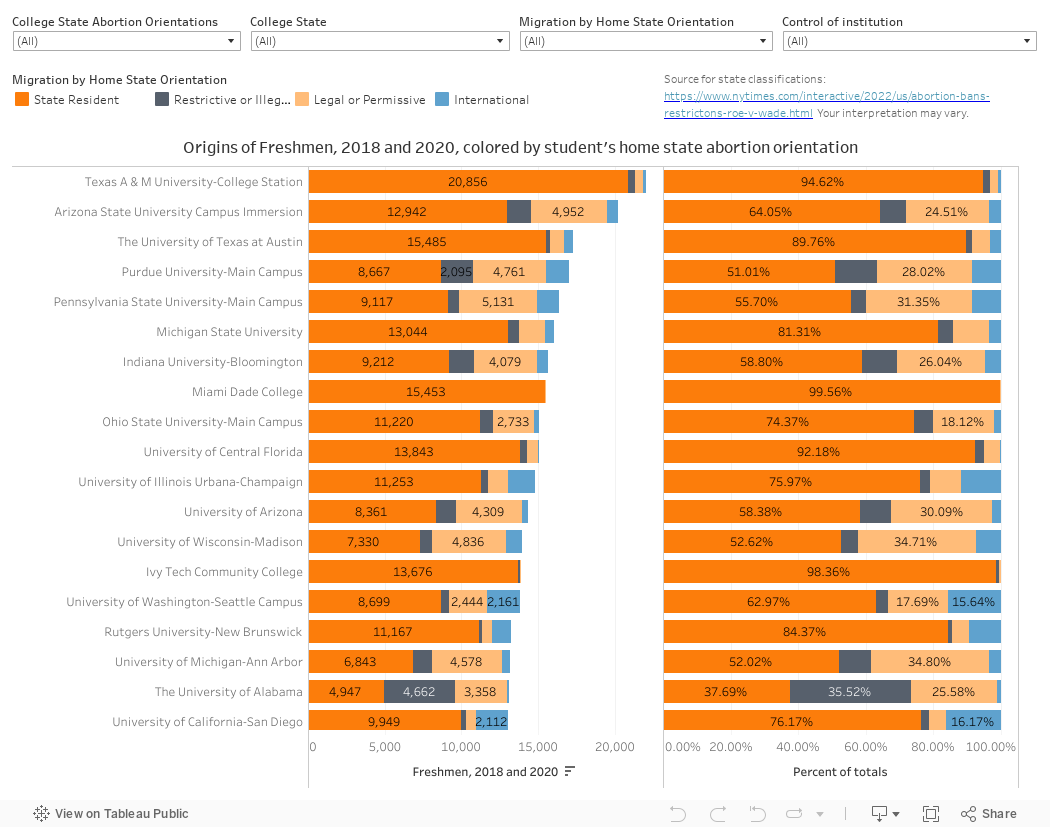
Abortion policy and freshman migration, 2018 and 2020

The recent SCOTUS ruling overturning Roe v. Wade has set off an interesting debate about student college choice.  People who favor legal access to abortion seem convinced that students--especially women--will change their college plans based on the climate in the state of the college(s) they're considering.

Will it?  I don't know.  I do know that when everyone seems to be convinced of something related to college admissions and student choice, the reality is often very different than the predictions, after all is said and done.  And on the other hand, this feels different, somehow.  To repeat: I don't know.

Of course, the ability of students to migrate across state lines is generally reserved for those with more wealth and privilege, and as I've demonstrated before (here and here), educated and wealthier communities tend to vote Democratic, and thus, are more likely to be pro-choice and more likely to be upset by the SCOTUS decision.  And I, like a lot of people, live in an echo chamber and mostly listen to people who share my political beliefs (which is also why I haven't heard from my brother since November, 2020.  But that's another story.)

Additionally, politics is probably already a factor in college choice for those students who can move out of state, and those who go to institutions with more conservative religious affiliations, like BYU, or Notre Dame, or Grove City.  Finally, not everyone is political, and not everyone disagrees with the SCOTUS ruling.

But I still wanted to look at the data, so here it is in a single view.  I looked at freshman migration in 2018 and 2020 to smooth out some of bumps that might be a result of COVID in 2020.  And before you ask, IPEDS only requires this data to be reported in even-numbered years, so we won't have 2022, let alone 2024, for a long time yet.

I broke down a college's freshman classes into four categories: State residents (the state breakdown tab here shows that about 79% of students attend college in their home state); international students, students from states with mostly unrestricted abortion laws, and students with more restrictive abortion laws.  Counts are on the left; percentages on the right.  I used the classifications here in case you were wondering, so argue with the New York times if you don't agree.

What do you see here?  Leave a comment below or hit me up on Twitter

Comments

Popular posts from this blog

Educational Attainment and the Presidential Elections

I've been fascinated for a while by the connection between political leanings and education: The correlation is so strong that I once suggested that perhaps Republicans were so anti-education because, in general, places with a higher percentage of bachelor's degree recipients were more likely to vote for Democrats. The 2024 presidential election puzzled a lot of us in higher education, and perhaps these charts will show you why: We work and probably hang around mostly people with college degrees (or higher).  Our perception is limited. With the 2024 election data just out , I thought I'd take a look at the last three elections and see if the pattern I noticed in 2016 and 2020 held.  Spoiler: It did, mostly. Before you dive into this, a couple of tips: Alaska's data is always reported in a funky way, so just ignore it here.  It's a small state (in population, that is) and it's very red.  It doesn't change the overall trends even if I could figure out how to c...

First-year student (freshman) migration, 2022

A new approach to freshman migration, which is always a popular post on Higher Ed Data Stories. If you're a regular reader, you can go right to the visualization and start interacting with it.  And I can't stress enough: You need to use the controls and click away to get the most from these visualizations. If you're new, this post focuses on one of the most interesting data elements in IPEDS: The geographic origins of first-year (freshman) students over time.  My data set includes institutions in the 50 states and DC.  It includes four-year public and four-year, private not-for-profits that participate in Title IV programs; and it includes traditional institutions using the Carnegie classification (Doctoral, Masters, Baccalaureate, and Special Focus Schools in business, engineering, and art/design. Data from other institutions is noisy and often unreliable, or (in the case of colleges in Puerto Rico, American Samoa, and other territories, often shows close to 100% of enro...

Education Levels in the US, by State and Attainment

Attainment has always been an interesting topic for me, every since I first got stunned into disbelief when I looked at the data over time.  Even looking at shorter periods can lead to some revelations that many don't make sense at first. Here is the latest data from NCES, published in the Digest of Education Statistics . Please note that this is for informational purposes only, and I've not even attempted to visualize the standard errors in this data, which vary from state-to-state.  There are four views year, all looking at educational attainment by state in 2012 and 2022.   The first shows data on a map: Choose the year, and choose the level of attainment.  Note that the top three categories can be confusing: BA means a Bachelor's degree only; Grad degree means at least a Master's (or higher, of course); and BA or more presumably combines those two.  Again, standard errors might mean the numbers don't always add up perfectly. The second shows the data o...