
Doctoral recipients in the US, by ethnicity over time

A while ago I published this visualization, showing the baccalaureate institutions of doctoral degree recipients over about 60 years.  It's a post I do every few years, and it always seems to be helpful for high school and independent counselors who work with students and families, and just interesting for the rest of us. 

Shortly after posting, I got an email from colleague Crys Latham at Washington Latin who wanted to know if you could look at that data by ethnicity.  The answer, unfortunately, is no: You can choose to download the data by undergraduate institution or ethnicity of the recipients, but not both.  (Perhaps NSF will give more granular data to bona fide academic researchers, so maybe someone can find out.) However, that got me thinking a bit, so I went back and looked at the tables again.

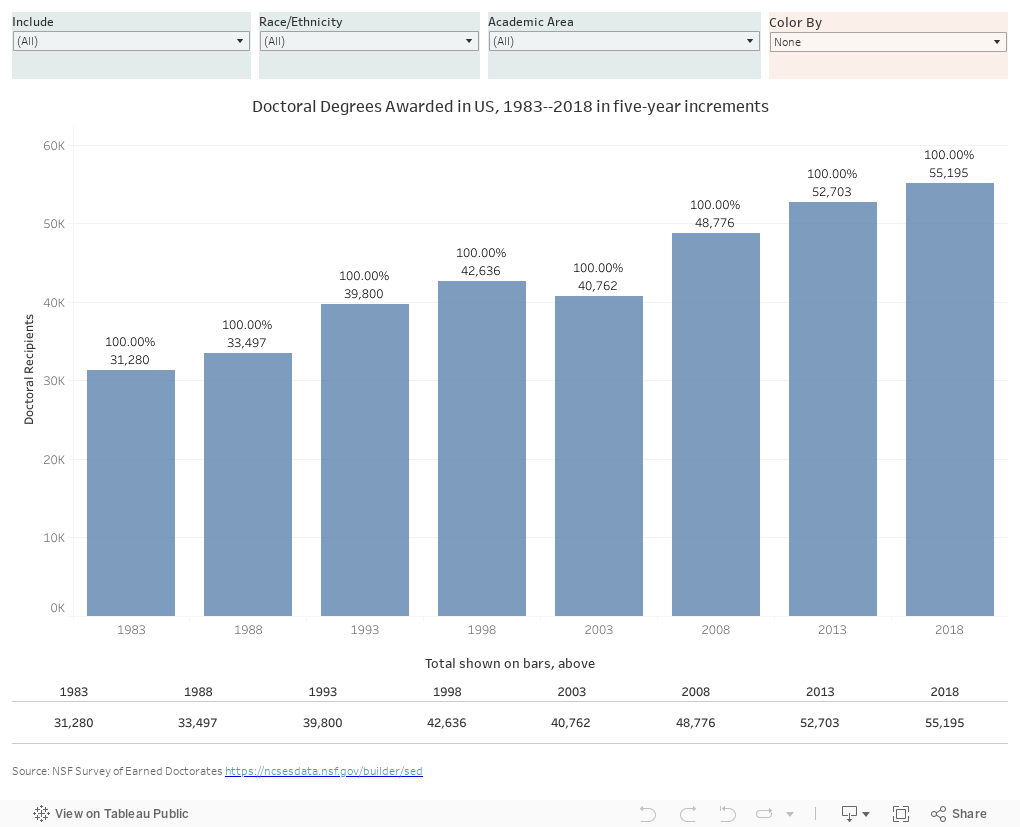
I downloaded ethnicity of doctoral recipients since 1983, in five year increments, and created the visualization below.  It's pretty simple, and if someone with better skills wants to make this visualization better, feel free; I left the Tableau workbook open for downloading.

First decide if you want to include all recipients or just those with known ethnicity (far left filter).  Then you can select any combination of ethnicity and academic area to see the trends over time (Asian recipients in social sciences, for instance).  But if you wish to choose only one of those, you can use the Color By control to color the bars by the other.  

For instance, choose "Black or African-American" on the race/ethnicity control, then color by "Academic Area."  You'll see that in 2018, about 20% of African-American recipients earned degrees in each of three areas: Education, Life Sciences, and Social Sciences.  Compare that to 1983, when half of the 1,009 African-American recipients earned doctorates in education.

As much as the growth is good news, the numbers can still be concerning: In 2018 fewer than 100 Hispanic doctoral recipients earned degrees in math and computer science.  Assuming many of them will not go to work at institutions of higher education, it shows how hard it can be for a university to attract and maintain a diverse faculty in some disciplines.  And of course, instead of being satisfied with the reality we see, it can cause us to ask why that is, and what we do about it.

As always, let me know what you see here that interests you.

Comments

Popular posts from this blog

Educational Attainment and the Presidential Elections

I've been fascinated for a while by the connection between political leanings and education: The correlation is so strong that I once suggested that perhaps Republicans were so anti-education because, in general, places with a higher percentage of bachelor's degree recipients were more likely to vote for Democrats. The 2024 presidential election puzzled a lot of us in higher education, and perhaps these charts will show you why: We work and probably hang around mostly people with college degrees (or higher).  Our perception is limited. With the 2024 election data just out , I thought I'd take a look at the last three elections and see if the pattern I noticed in 2016 and 2020 held.  Spoiler: It did, mostly. Before you dive into this, a couple of tips: Alaska's data is always reported in a funky way, so just ignore it here.  It's a small state (in population, that is) and it's very red.  It doesn't change the overall trends even if I could figure out how to c...

First-year student (freshman) migration, 2022

A new approach to freshman migration, which is always a popular post on Higher Ed Data Stories. If you're a regular reader, you can go right to the visualization and start interacting with it.  And I can't stress enough: You need to use the controls and click away to get the most from these visualizations. If you're new, this post focuses on one of the most interesting data elements in IPEDS: The geographic origins of first-year (freshman) students over time.  My data set includes institutions in the 50 states and DC.  It includes four-year public and four-year, private not-for-profits that participate in Title IV programs; and it includes traditional institutions using the Carnegie classification (Doctoral, Masters, Baccalaureate, and Special Focus Schools in business, engineering, and art/design. Data from other institutions is noisy and often unreliable, or (in the case of colleges in Puerto Rico, American Samoa, and other territories, often shows close to 100% of enro...

Education Levels in the US, by State and Attainment

Attainment has always been an interesting topic for me, every since I first got stunned into disbelief when I looked at the data over time.  Even looking at shorter periods can lead to some revelations that many don't make sense at first. Here is the latest data from NCES, published in the Digest of Education Statistics . Please note that this is for informational purposes only, and I've not even attempted to visualize the standard errors in this data, which vary from state-to-state.  There are four views year, all looking at educational attainment by state in 2012 and 2022.   The first shows data on a map: Choose the year, and choose the level of attainment.  Note that the top three categories can be confusing: BA means a Bachelor's degree only; Grad degree means at least a Master's (or higher, of course); and BA or more presumably combines those two.  Again, standard errors might mean the numbers don't always add up perfectly. The second shows the data o...