
What Happens to 100 9th Grade Students in Your State?

While waiting for 2014 IPEDS data to come out, I've been searching the web for more good educational data to visualize, and came across this site, where I found a nice little data set.  It's from 2010, and tracks 9th graders through high school and college.

We typically think of looking at high school graduates and measuring how well they do, which is important, of course.  But you can have a high percentage of graduates enrolling in or graduating from college masking a problem of high school dropouts.  This data helps look at that.

For all the data here, assume you start with 100 students in 9th grade in the state:

  • What percentage of them graduate from high school?
  • What percentage of them enter college?
  • What percentage make it to the sophomore year of college?
  • What percentage graduate from college within 150% of normal time (in other words, within six years)?
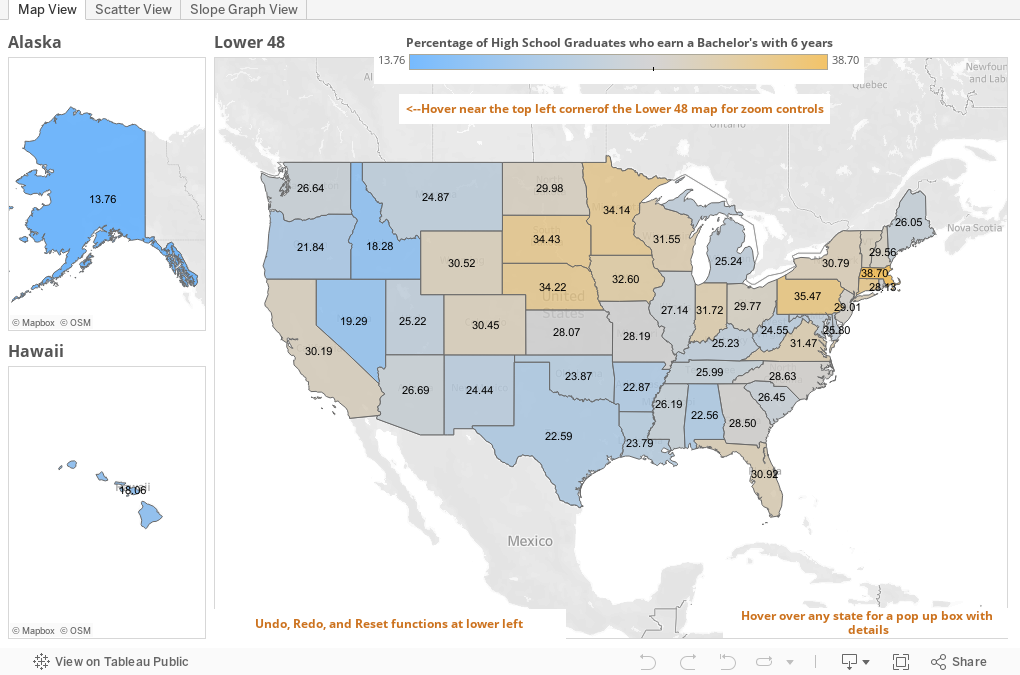
Finally, there is another, more traditional measure included: The percentage of high school graduates who graduate from college.

The data are interesting by themselves, but I also rolled in census data of median family income by state in 2001, presumably the year the 9th grader tracking began.  It's by no means perfect: New York City and Elmira in New York, for instance; Dallas and Colorado City in Texas; or Hollywood and Fresno in California share very little except a state capitol. I've made no adjustments for purchasing power of a dollar, either.  The high incomes in Alaska mask a much higher cost of living, and the remoteness of the state and relative dearth of post-secondary options make its attainment rating skew low, in all probability.

  • On the first view, the map, hover over any state to get a popup chart.  Go to the top left corner of the 48 States map to zoom; resets are at the lower left of the visualization.  The states are colored by the percentage of high school graduates who earn a college degree.
  • One the second view, the scatter gram, the x-axis is always the rank of median family income. Choose any other value to plot on the y-axis.  The states are colored by region, and you should note that the axes are reversed, so a rank of 1 is high and to the right.
  • And, of the third view, a slope graph, where you can compare any two measures of educational attainment in the states by using the right and left controls.  The line connects the two ranks.
What do you see here? I'd love to hear your thoughts.


Comments

Popular posts from this blog

Changes in AP Scores, 2022 to 2024

Used to be, with a little work, you could download very detailed data on AP results from the College Board website: For every state, and for every course, you could see performance by ethnicity.  And, if you wanted to dig really deep, you could break out details by private and public schools, and by grade level.  I used to publish the data every couple of years. Those days are gone.  The transparency The College Board touts as a value seems to have its limits, and I understand this to some extent: Racists loved to twist the data using single-factor analysis, and that's not good for a company who is trying to make business inroads with under-represented communities as they cloak their pursuit of revenue as an altruistic push toward access. They still publish data, but as I wrote about in my last post , it's far less detailed; what's more, what is easily accessible is fairly sterile, and what's more detailed seems to be structured in a way that suggests the company doesn...

Educational Attainment and the Presidential Elections

I've been fascinated for a while by the connection between political leanings and education: The correlation is so strong that I once suggested that perhaps Republicans were so anti-education because, in general, places with a higher percentage of bachelor's degree recipients were more likely to vote for Democrats. The 2024 presidential election puzzled a lot of us in higher education, and perhaps these charts will show you why: We work and probably hang around mostly people with college degrees (or higher).  Our perception is limited. With the 2024 election data just out , I thought I'd take a look at the last three elections and see if the pattern I noticed in 2016 and 2020 held.  Spoiler: It did, mostly. Before you dive into this, a couple of tips: Alaska's data is always reported in a funky way, so just ignore it here.  It's a small state (in population, that is) and it's very red.  It doesn't change the overall trends even if I could figure out how to c...

Changes in SAT Scores after Test-optional

One of the intended consequences of test-optional admission policies at some institutions prior to the COVID-19 pandemic was to raise test scores reported to US News and World Report.  It's rare that you would see a proponent of test-optional admission like me admit that, but to deny it would be foolish. Because I worked at DePaul, which was an early adopter of the approach (at least among large universities), I fielded a lot of calls from colleagues who were considering it, some of whom were explicit in their reasons for doing so.  One person I spoke to came right out at the start of the call: She was only calling, she said, because her provost wanted to know how much they could raise scores if they went test-optional. If I sensed or heard that motivation, I advised people against it.  In those days, the vast majority of students took standardized admission tests like the SAT or ACT, but the percentage of students applying without tests was still relatively small; the ne...