Most of the things I look at have to do with publicly available data sets, and that often means undergraduate admissions. But while doing some investigation, I came across data from the American Association of Medical Colleges. There's some interesting stuff there, and while it's formatted in a way that makes it really difficult to get to, it's worth a little work. (I'm not convinced that the formatting isn't an attempt to keep less stubborn people from digging too deep on this; my request to get the data in a better format was ignored.)
Best thing I learned: In 2014, of the 49,480 applicants to medical school, 41.1%, or 20,343, enrolled. That's a far higher percentage than I would have thought, although it is lower than the 2003 rate of 47.5% (34,791 and 16,541, respectively.) It's clear, of course, that most medical school applicants are very well qualified, so that number represents the best of the best, but the perception of medical school selectivity is driven by the rates at each individual institution (sometimes 5% or less); in fact, each student applies, on average, to about 15 medical colleges, which skew the numbers. These numbers are just for M.D. admissions, not D.O. or other medical professions.
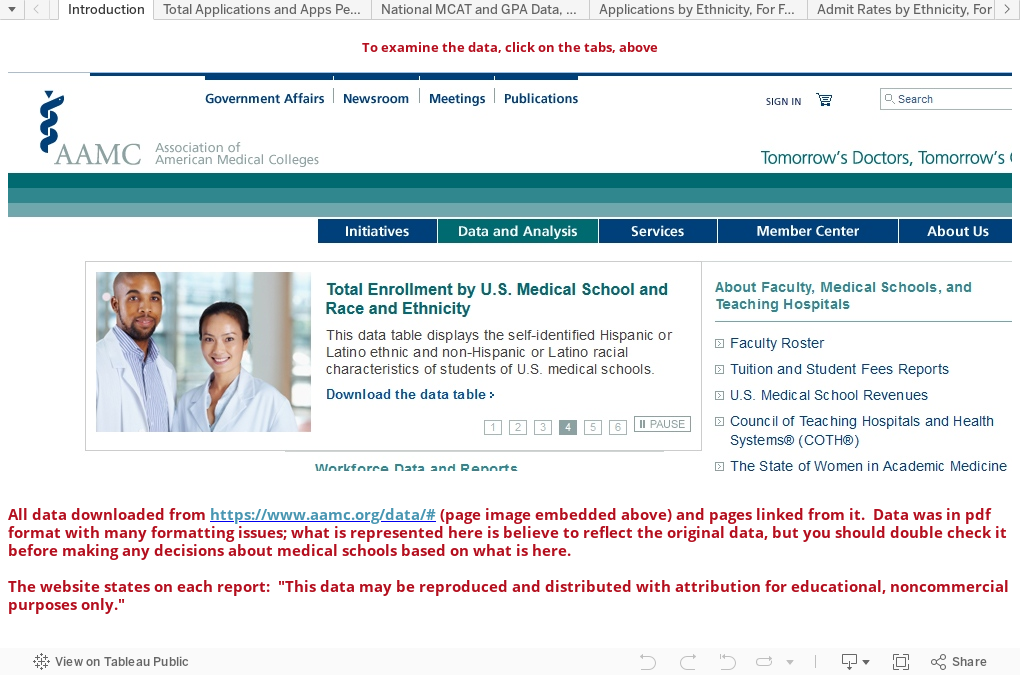
This visualization has seven views, and starts with an intro. You can get to the other six by clicking the tabs across the top:
Best thing I learned: In 2014, of the 49,480 applicants to medical school, 41.1%, or 20,343, enrolled. That's a far higher percentage than I would have thought, although it is lower than the 2003 rate of 47.5% (34,791 and 16,541, respectively.) It's clear, of course, that most medical school applicants are very well qualified, so that number represents the best of the best, but the perception of medical school selectivity is driven by the rates at each individual institution (sometimes 5% or less); in fact, each student applies, on average, to about 15 medical colleges, which skew the numbers. These numbers are just for M.D. admissions, not D.O. or other medical professions.
This visualization has seven views, and starts with an intro. You can get to the other six by clicking the tabs across the top:
- A scatter, showing each medical college, colored by region, on two scales: Total applications and the number of applications per seat
- Historical data for MCAT and GPA performance for applicants and matriculants over time
- Applications, by ethnicity. These are in a heat map format; the orange squares represent the highest vales on that individual grid
- Admit rates, by ethnicity. This represents (I'm 99% sure) the chance that a student in the category show, represented by the intersection of column and row, was admitted to at least one of the schools she applied to
- Applications per seat in the entering class, broken out by male, female, and in-state status
- Matriculant diversity, shown as male/female and in-state/out-of-state
By the way, if you need some understanding of MCAT scores, you can see them by clicking here.
If you're like me, you have a lot of questions that are not answered by the data AAMC provides. But it's still a good start. What do you notice here?
Comments
Post a Comment